How Foreigner Made 'Urgent'
A couple of obsessive-compulsives. One sax legend. And a bunch of Frisbees. Equals an era-defining smash.

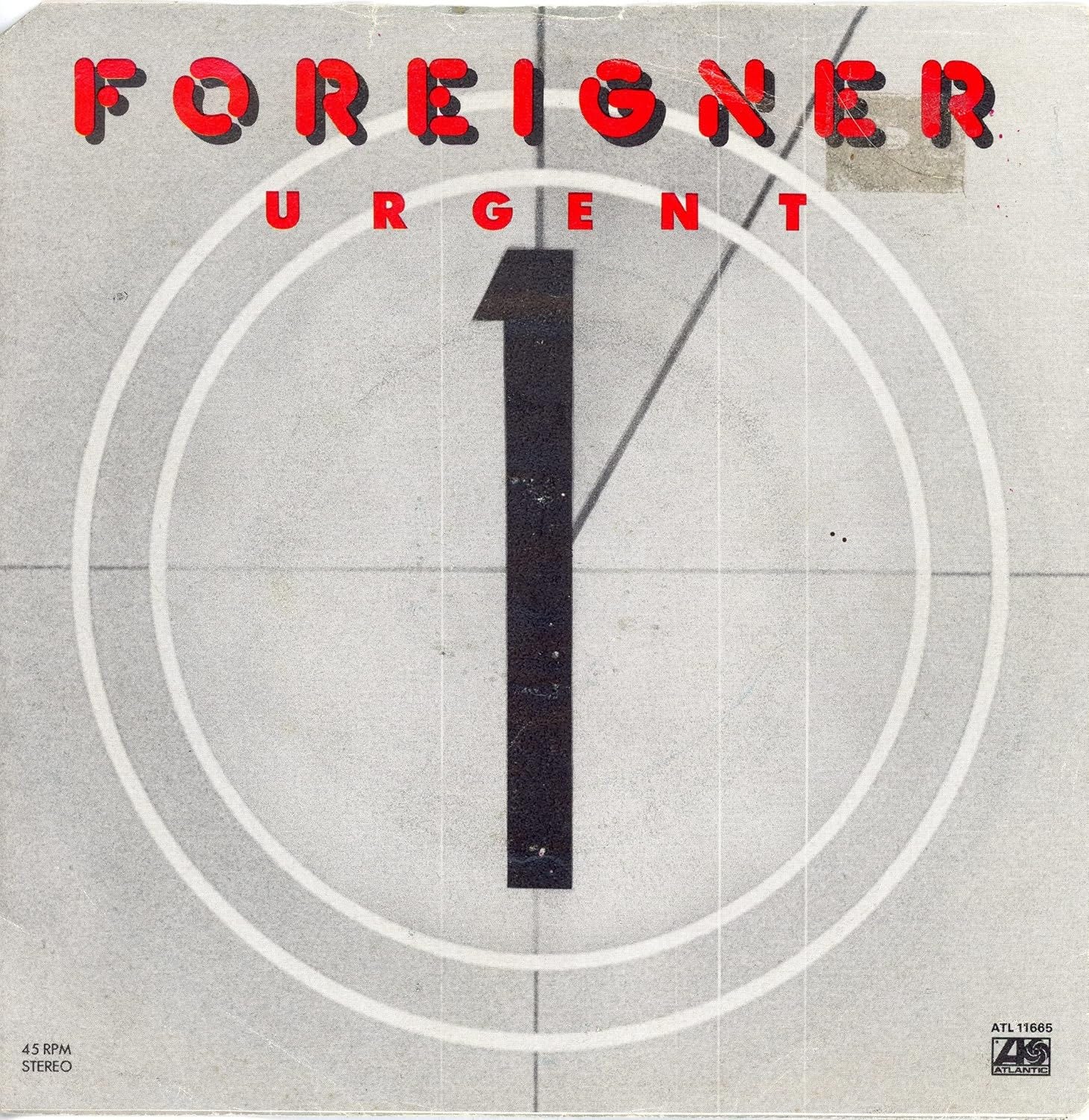
IN THEIR FIRST FOUR years together, Foreigner had exploded and then fizzled. Founded by an Englishman in New York, ex-Johnny Hallyday and Spooky Tooth guitarist Mick Jones, their self-titled debut album of 1977 went on to shift five million copies in the US. The following year’s Double Vision did even better. Hot Blooded from 1979, cursed with an unsavoury cover picture of a pre-pubescent girl in a men’s urinal, brought them crashing back to earth.
Under pressure from their record label, Atlantic, to re-correct his band’s trajectory, Jones, erudite but ruthless, summoned a meeting with singer Lou Gramm, bassist Rick Wills, and drummer Dennis Elliott, at which the two absent members of the group, guitarist Ian McDonald and keyboard player Al Greenwood, were fired. A difficult, tortuous process according to Jones, but who didn’t look back. He had a fourth album to steer, and a producer in mind.
Robert John ‘Mutt’ Lange had got his start in the music business writing radio jingles in his native South Africa. Relocated to London, he’d produced records for Graham Parker and the Boomtown Rats. Lange had lobbied for the job on Double Trouble, but just then Jones appraised him to be “going through something in his life… not in the best shape,” and hired the more seasoned Keith Olsen instead. Lange was now on a hot streak from making back-to-back hit albums with AC/DC, Highway to Hell and the juggernaut Back in Black.
By reputation already, he was man of fine details. His quest to create the perfect sound bordering on, if not hurtling galaxies beyond the point of obsession. In other words, in respect of this Lange was very much like Jones himself. The two of them, joined by Gramm, Wills, Elliott, an English keyboard player hired by Lange, Thomas Dolby, and soon enough, a legendary son of Motown, stellar sax player Junior Walker, entered the storied Electric Lady Studios in Greenwich Village in September 1980 and began work on what was to become Foreigner’s 4 album. Inevitably, sparks flew.
Mick Jones: “I totally went into 4 on a mission to create the complete album. One of Mutt’s great strengths is he’d come up in radio. Because of that background, he had a very acute pop sensibility, a flair for short, sharp choruses, and also an understanding of the discipline of being in a studio. He was pushy, challenging, and absolutely relentless. The two of us are both quite strong-willed personalities and he didn’t mind upsetting me, but we managed to harness that together. We pushed each other to be our best.”
Thomas Dolby: “Mutt was a perfectionist, incredibly fastidious. He would make you do 23 takes of things even when you were way past the point of diminishing returns.”
Mick Jones: “Our first big bust-up was over drums. The third or fourth day of the sessions, Mutt came in with these electronic drums he wanted to use. I wanted real drums, but Mutt was insistent that Dennis’s timing wasn’t perfect. So I took Dennis out into the main room and together the two of us ran through one song, ‘Break it Up’, the whole thing, top to bottom. Dennis was right on the money, absolutely flawless. I stomped back into the control room and said to Mutt, quite aggressively, ‘Is that what you were looking for?’”
“There was a little too much imbibing the cocktails of the day, shall we say.” - Mick Jones
Thomas Dolby: “Mutt was staying in a suite in a hotel on Central Park South, and he let me have the pull-out couch in the living room. Often, he’d come back from the studio a couple of hours later than me. I would hear him in the bedroom, playing an acoustic guitar, singing Van Morrison songs. Two or three hours later, he’d get up and go back to the studio.”
Mick Jones: “The track we prepared for ‘Urgent’ had a bit of an urban vibe to it. It had the slap bass and the funk thing going on. I was living in a house in upstate New York at the time. I went home one afternoon, a beautiful day, and I sat in the living room with a little cassette player, going over and over the song. I wrote the lyric in a couple of hours. When you get that sort of flow going, and it’s fresh, you just have to ride it.”
Thomas Dolby: “In the studio, I worked more with Mick Jones than anyone else. He had the roadies set up some amps and a Fender Rhodes so that we could jam together. That, traditionally, is how musicians’ bond, but I don’t jam. My fingers are always a couple of bars behind my brain. He must have thought I was a complete amateur.”
Mick Jones: “We were on a break in the studio, and I was reading the Village Voice, just to check out who was in town. I see Junior Walker’s name, and I put two and two together. The song felt like it had the feel of one of those classic Junior Walker things, like ‘Roadrunner’. I went down to the club he was playing and sat through three sets. Eventually, his son, who was playing drums in his band, recognised me. Junior came out and his son said to him, ‘Dad, this dude is serious, and he wants to talk to you.’
“For all the stuff he’d done at Motown, Junior had never before overdubbed onto a track. That was the first hurdle, getting him comfortable. Then he goes over to the mic, pulls up a chair, and sits down like a jazz player. We did a few passes, and he was playing this sort of lounge-type fill without any of his trademark high notes, or squeaks. He informed me this was his new style. I had to tell him, with all due respect, that his new style was not what we were looking for.”
Thomas Dolby: “It was not uncommon for Mutt to sit for 12, 13, 14 hours on the trot in the control room. One day, just like any other day, we’d been sitting there like that, and Mutt suddenly pipes up, ‘We need to go to the park!’ So, we order a limo, and Mutt and me and his engineer, Mike Shipley, drive off uptown. Mutt goes, ‘Isn’t there a giant toy store around here?’ The limo driver says, ‘FAO Schwarz?’ ‘Stop off there!’ Mutt runs into the store, and he comes back out with every brand and size of Frisbee they had.
“We drive another few blocks to Central Park, where Mutt again runs off ahead of us. Next thing, we’re all of us hurling these Frisbees around the park. After ten minutes at most, Mutt shouts out, ‘What the fuck are we doing?! We’ve got an album to make!’ And back to the studio we go in the limo.”
Mick Jones: “Mutt and I spent two nights completely dedicated to editing the sax solo and making it sound right. Junior did three or four takes. They were all great, but they weren’t great all the way through, so we had to chop and change. The finished solo was made up of something ridiculous like 24 snippets of tape stuck together. Later, Junior came out and did the song with us at five arena shows and he played the identical solo, note for note. It was stunning.”
John Kalodner (Foreigner’s A&R representative at Atlantic): “Foreigner had a star writer team in Lou Gramm and Mick Jones. They had a star singer. So I had to focus both of them on the songs. That was the trick. It turned out amazing. It was just the right combination Mick wanted. The big vocals, and the power of the band.”
Mick Jones: “When I heard the finished record, I knew we’d made a big album. It did, however, come at a cost. I was there for every minute of the sessions, and I was in desperate need of a break. The effects of that have lasted right up to today. Even now, I’ve an almost pathological aversion to hanging out in recording studios.”
Thomas Dolby: “I went home with a pile of cash in my pocket. That basically enabled me to pay for my own album.”
Mick Jones: “Rather than take any time off, we went back out on the road within two weeks of finishing the record. For 18 months, we headlined stadiums and sold-out venues all over the world. It was tough to stay grounded in any possible sense. The best word to describe the whole tour would be ‘extravagant’. There was a little too much imbibing the cocktails of the day, shall we say. All too often when happy hour would go on for much longer than 60 minutes. Living the high life. You can very easily lose focus when you’re experiencing that type of success. In the back of my mind there was also the constant question of where we could possibly go from that point.”
Quotes extracted from my new book, Raised On Radio: Power Ballads, Cocaine & Payola – The AOR Glory Years 1976-1986. Out 24th February and available to pre-order here: Amazon UK Barnes and Nobel