How Rainbow Really Made 'Since You Been Gone'
A haunted castle, a singer the guitarist guarded against getting a haircut, and the evergreen hit the drummer loathed so much he wouldn't play on it...

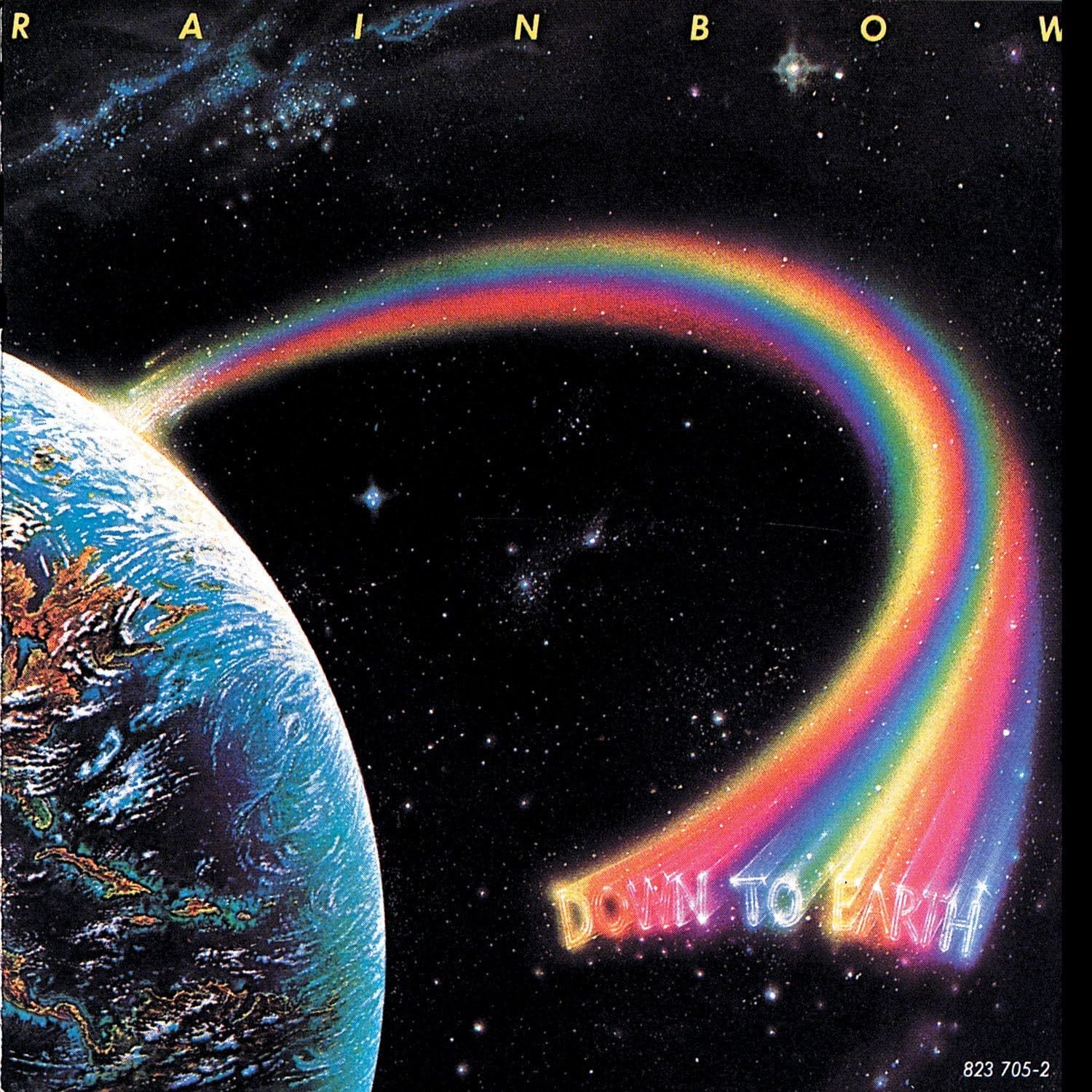
IT’S FEBRUARY 1979 AND Ritchie Blackmore and what’s left of his band Rainbow have journeyed to a French castle to make their fourth album. Chateau Pelly de Cornfeld is located on the border with Switzerland. The lovely lakeside city of Geneva is just a short drive away. From the grand old building’s windows, the view looks out to snow-capped Alpine peaks.
Very probably, Blackmore had other things occupying his mind just then than the idyll. For one thing, Rainbow was absent of a singer. Then again, they’d travelled to France without managing to have written a single new song for the record. The one they did have was a cover song Blackmore had brought along with him. A pop-rock confection, quite unlike anything previously bearing the Rainbow name, and titled ‘Since You Been Gone’.
Such had been the turbulent history of Rainbow to this point. Flouncing out of Deep Purple in 1975, Blackmore had essentially recruited one of their old support groups, Elf, to help him make his new one’s debut album, Ritchie Blackmore’s Rainbow. By the following year, only Elf’s singer, Ronnie James Dio, remained in the ranks, joined now by ex-Jeff Beck drummer Cozy Powell, a Scot, Jimmy Bain, on bass, and an American, Tony Carey, on keyboards.
Together, this line-up fashioned one of the titanic hard rock records of the era, Rising. Blackmore’s guitar pyrotechnics, Dio’s powerhouse voice, and the might of the Munich Philharmonic combined on its signature, eight minutes-plus epic, ‘Stargazer’. Even still, Blackmore bristled. Out went Bain and Carey, in respectively came Australian Bob Daisley and Canadian David Stone for 1978’s Long Live Rock ‘N’ Roll, a near-classic, six brilliant tracks, all muscle and melody, out of eight.
Of his experience working with the enigmatic Blackmore, Daisley told me, “I always found him to be a very aware person, intelligent, but he could be a bit quirky, and he didn’t suffer fools gladly or easily. I came to terms with the fact that it was Ritchie’s band, but I think Ronnie, more than anyone, had a problem with that fact.
“Ritchie was a bit quirky. He didn’t suffer fools gladly or easily.” - Bob Daisley
BREAKING POINT FOR BLACKMORE and Dio arrived in October 1978. Blackmore had gathered yet another new Rainbow line-up in the verdant Connecticut town of Darien, where both he and Dio kept homes, to rehearse their next record. Stone was gone by then. Daisley, too. In their stead were an English keyboard player known to Powell, Don Airey, and Blackmore’s erstwhile Purple bandmate Roger Glover, a bassist but there as Rainbow’s freshly appointed producer.
Ever wilful, Blackmore it was who’d instigated Glover’s, and his friend Ian Gillan’s ruthless ousting from Purple five years previous. Glover had gone on to produce records for Scots rockers Nazareth and Elf. Enough for Blackmore to invite him back into his fold. For his part, Glover claimed not to hold a grudge.
“I thought, ‘Why not?’” he reasoned. “Ritchie was playing brilliantly and it was a good opportunity for me.”
Soon enough, Glover also found himself co-opted into playing bass in the band and after Blackmore had tried out, and dismissed, two other musicians for the role, Jack Green, ex-Pretty Things and a friend of his, and Clive Chaman, who’d been with Powell in Beck’s group. In all other regards, the sessions were catastrophic. Blackmore was intent on steering Rainbow in a more radio-friendly direction. Dio resisted him at every turn.
A week went by with nothing very much getting done. By Glover’s description, one day after the next, Blackmore would lead his fellow musicians through the pieces of ideas he was working up and as Dio sat off in a corner, absently scribbling in his notebook, or else staring off into space, but hardly bothering to sing. One particular evening, Blackmore summoned Glover over to his house. He had a tape of a new scrap of a song he wanted delivering to Dio for his consideration. Glover obliged him.
“I went on over to Ronnie’s and played him the tape,” he said. “He shrugged it off, and in return handed me a tape of his own he wanted me to play for Ritchie, whose reaction was just as dismissive. There was a huge gulf between them.”
Inevitably, Dio quit. So it was the latest incarnation of Rainbow came to find themselves in France a man down and seven songs short of an album.
“It was the same old bollocks. The moods. Being late, playing badly on purpose, and being rude to everyone.” - Don Airey
BLACKMORE LIKED TO RECORD in castles. He’d angled to have Long Live Rock ‘N’ Roll made in another French one, Chateau d’Herouville, outside of Paris. Dating from the 13th Century, Chateau Pelly de Cornfeld was reputedly haunted, also a hook for Blackmore. Its present owner was a Turkish-born international financier, Bernie Cornfeld. A colourful character, Cornfeld had dated both Audrey Hepburn and Dallas pin-up Victoria Principal and was just then about to stand trial in Switzerland on fraud charges.
They set up in the extravagantly appointed dining room with its stone walls, vaulted ceiling, and wooden beams. Jethro Tull’s mobile studio, hired for the occasion, parked up outside, leads and cables snaked through the open windows. In due course, they pulled together the required number of songs. Punchier, more streamlined offerings than those that had preceded them, and but for one throwback, ‘Eyes of the World’.
With Dio gone, Glover stepped up once more to becoming Blackmore’s co-writer and designated lyricist. Where Dio’s words occupied fantastical realms populated by dragons and wizards, Glover’s concerns were decidedly more earthbound. Witness ‘Makin’ Love’, ‘Lost in Hollywood’, and especially ‘All Night Long’, with its singularly ungallant proclamation, “Don’t know about your brain but you look alright.”
It was ‘Since You Been Gone’, though, that was the most emblematic of the musical volte-face Blackmore was orchestrating. Written by former Argent frontman Russ Ballard for his 1975 solo album Winning, it hadn’t been a hit first time around. Since when, an all-female band from South Africa, Clout, and Head East, rockers from Illinois, had each taken a stab at it. Blackmore had been tipped to it by Rainbow’s manager, Bruce Payne.
Both men thought it the potential calling card they were in need of to crack open FM radio to Rainbow in the States. Cozy Powell, an old-school hard hitter, loathed it to the extent he refused to play on it. Against this backdrop, Blackmore had several singers flown out to France to audition. None matched his checklist, which was for someone with the soul and grit of Paul Rodgers and as well the stratospheric range of Lou Gramm of Foreigner.
At the end of one day’s recording, they fell to a game of ‘Name That Tune’. Powell picking out the selections from his collection of ’60s tapes. One song, a Bee Gees cover, ‘Only One Woman’, a Top Five hit in the UK in 1968 for British duo Marbles, caught Blackmore’s ear. Specifically, its singer, Skegness-born Graham Bonnet (it’s pronounced Bonn-ey).
“Where is he now?” Blackmore asked of the assembled.
In point of fact, Marbles’ burst of fame was brief. After their one hit, Bonnet and his cousin, Trevor Gordon, went their separate ways. Bonnet to singing TV jingles. Then, the year previous, he’d struck gold again with a second Bee Gees tune, ‘Warm Ride’, a leftover from the Saturday Night Fever sessions and which took him to Number One in Australia. As luck would have it, Glover knew of a fellow producer who’d even more recently recorded a session with Bonnet. Calls were made, and it was arranged for Bonnet to fly out to France.
BONNET SAW HIMSELF AS an R&B singer. That he was a man apart was obvious from the moment he turned up at the Chateau. Bonnet was attired for his audition in a suit and tie, his hair short and slicked back. He looked like nothing so much as a well-scrubbed James Dean.
He knew next to nothing about hard rock in general, never mind Rainbow’s music. Told in advance he’d be required to sing a Deep Purple song, ‘Mistreated’, he’d rushed out to buy a bunch of Purple and Rainbow records in order to familiarise himself with them. In the event, and even though he ran through ‘Mistreated’ off mic, he made a powerful impression.
“I thought the same as everyone else in the band,” Airey recalled. “The greatest singer any of us had ever heard.”
They offered him the job on the spot. By then, there were seven songs simply needing a lead vocal adding to them. Nevertheless, the process from there was fractious and painstaking. Glover coached Bonnet to sing each song four different ways. Blackmore chose the best version.
“Roger,” recalled Bonnet, “would give me a vague idea of melody and tell me to do whatever I wanted to make the song my own.”
That much wasn’t enough for him to gain any writing credits on the finished record. A source of frustration to Bonnet ever since.
“They knew I was the new boy,” he said to me. “And they pulled the wool over my eyes.”
Further frustrating him, the cavernous, echoey dining room was ill-suited to recording vocals. After two weeks’ trial and error, they decided to shift operations back to the American East Coast. Before they left France, Glover did at least order Powell into putting a drum track down on ‘Since You Been Gone’, albeit with a bare minimum’s effort on Powell’s part.
“He expressed his feelings by playing something overly simple,” said Glover.
Newly ensconced at Kingdom Sound, a studio on Long Island, Blackmore, Airey, and Glover added their parts to the song. Glover boosted Bonnet’s subsequent lead vocal with stacked back-ups, and additional percussion, and in the altogether, Powell’s cursory backbeat worked entirely in the song’s favour, driving it along. ‘Since You Been Gone’ had a punch to it, no doubt about it.
Chosen as the first single off the album, Down to Earth, it was released on 31st August 1979 and progressed to being a Top Ten hit in the UK, and the desired gate crasher in America. Behind it, Rainbow set off on tour, beginning on the 2nd September 1979 in Lakeland, Florida, and from there, to three months’ criss-crossing North America, coast to coast.
“I probably enjoyed it too much,” Bonnet admitted of his one and only Rainbow tour. “There was always loads of booze in the dressing room, and along with a lot of girls.”
This being Rainbow, there was friction, too. Principally brought about by Bonnett’s penchant for sporting tailored jackets, Hawaiian shirts and aviator shades onstage, and the degrees to which this needled Blackmore. As the tour stretched out, Bonnet found the key to his wardrobe being spirited from his dressing room, or else items of his clothing vanishing altogether.
“Ritchie would throw my stuff away,” he insisted. “That was something that did get a bit nasty. I just wasn’t into the uniform at all, which is to say, spandex pants and Cuban heel boots.”
By the time they pitched up in the UK, the winter following, Blackmore had taken to stationing a roadie to stand guard outside of Bonnet’s dressing room door, there to prevent him from sneaking out to get a haircut. Bonnet rebelled in Edinburgh, 22nd February 1980, a Friday. They were playing the city’s Ingliston Exhibition Centre that night. Bonnet slipped out through a window, made for a local barbershop, and asked for an especially severe crop.
“I didn’t see Ritchie, or anyone else, until I went onstage,” he said. “Ritchie came on, clocked my hair, and walked straight back off. He ended up playing the entire gig from behind his amplifiers.”
“It was a fucking great band. But I’ve never listened to the whole of that album since the day I left.” - Graham Bonnet
TWO MONTHS AFTER THE tour ended, the summer of 1980, Rainbow regrouped at Sweet Silence Studios in the Danish capital of Copenhagen. There was another new record needing to be made, another new line-up to do it. Bonnet was still there, along with Glover and Airey, but not Powell, gone off to a better paying gig with the Michael Schenker Group. Blackmore pitched up with a replacement drummer, an American, Bobby Rondinelli, a bar-band player.
Blackmore was also armed with a second Russ Ballard song, ‘I Surrender’. Bonnet got so far as to put down a guide vocal on it, and before the session ground to a halt. Blackmore, said Bonnet, “pretty much stopped coming to the studio. It was all very strange, and boring.”
“The same old bollocks,” appraised Airey. “The moods. Being late, playing badly on purpose, and being rude to everyone.”
Airey told Bonnet he meant to jump ship. Airey, ultimately, stayed on. Bonnet didn’t, fleeing back to his newly adopted home in LA. They tried to persuade him to return, he insisted, but his mind was made up.
“I should have stuck it out,” he said, with hindsight. “I mean, even my mum and dad and my then wife asked me what the hell I thought I was doing.”
Rainbow carried on without him, recruiting an American singer, Joe Lynn Turner for three more records, and until Blackmore and Glover bailed for the Deep Purple reunion of 1984. Bonnet followed Powell into the Michael Schenker Group and for a second combustible, all-too-short tenure. These days, he continues to lead his own band, still out there singing ‘Since You Been Gone’ every night.
“It was a fucking great band and people love those songs,” he said to me of his time with Ritchie Blackmore’s Rainbow. “But I’ve never listened to the whole of that album since the day that I left.”
Excellent!