Return Of The King
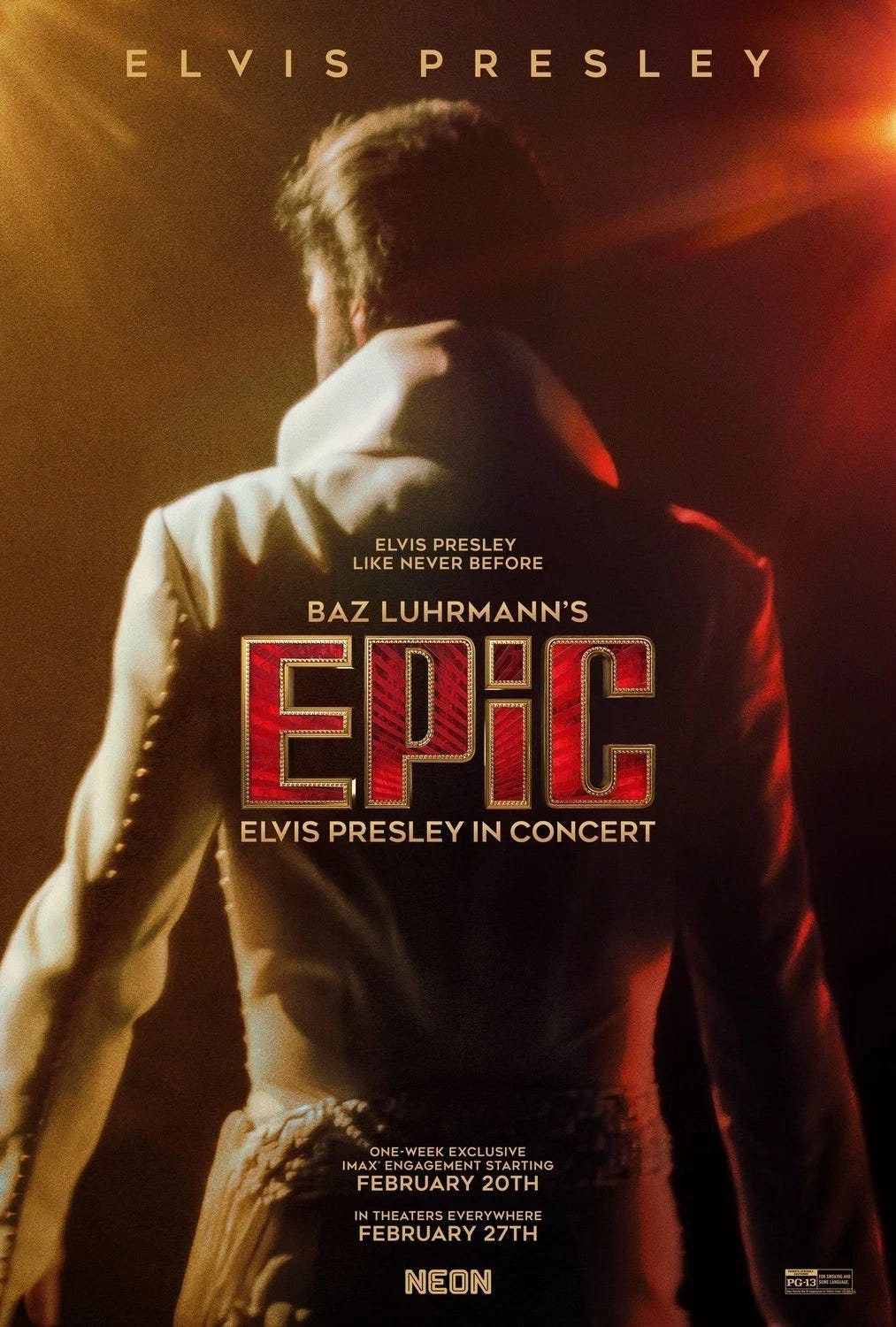
Baz Luhrmann's Elvis movie, EPiC, is a concert film like no other.

THERE’S ONE PARTICULARLY TELLING vignette in Peter Guralnick’s masterful biography of Elvis Presley, Careless Love. It’s 1969, and Elvis is in LA, holding auditions to fill spots in the Taking Care of Business Band that will back him on the month-long residency he has scheduled at The International Hotel in Las Vegas later that summer. Jerry Scheff was persuaded to try out on bass. A seasoned session player by then, Scheff was not at all predisposed to Elvis’ music. His roots were in R&B and jazz, and even before his appointed date with Presley at a poky rehearsal studio on Franklin and Vine, he’d made up his mind not to take the gig if offered. Scheff thought otherwise on the spot.
“I came home that day and told my wife, ‘You gotta come down here and check this guy out,’” Scheff related to Guralnick. “She said, ‘Ah, come on,” and I said, ‘No, really, you’ve got to hear this guy,’ and I didn’t say anything else. But the next day he just blew her away. Blew us both away.”
I mention this because it’s the nub of Baz Luhrmann’s new documentary film, EPiC: Elvis Presley in Concert. Assembled by Luhrmann from 68 boxes of footage recovered from the Warner Brothers archives, EPiC essentially is about one thing, and one thing only. Elvis Presley on stage, in his element, a spectacular force of nature.
Sure, it opens with a whistlestop tour through Presley’s rise out of dirt-poor Tupelo. A barrage of eternally familiar, mostly black and white clips. Elvis hips-swivelling across a plywood stage knocked up in the middle of some boondock field, pre-pubescent screams backdropping his progress. Elvis with the Colonel. Elvis on Ed Sullivan and in his army fatigues. Sandwiched between his adoring mother, Gladys, and stern-looking father, Vernon, and playing dumb in one vacuous movie after another, those soul-crushing Hollywood years.
Then the 1968 Comeback Special happens, and Elvis is back on the road, where for the most part he’ll stay for the next, and last eight years of his all-too-short, all-too-much life. In the film, the strident strains of his intro music, Richard Strauss’ ‘Also Sprach Zarathustra’, swell and we see Elvis in the moment, white-and-rhinestone jump-suited, ink-black pompadour, a living, breathing icon-cliché, stood behind the stage curtain, all jumpy, nervy, kinetic energy. The TCB Band strikes up, and he walks into the spotlight. The unseen crowd out there in the dark roars and for the next 90 minutes you, like them, fix your eyes on him, and stay fixed, because it’s simply impossible to do otherwise.
“I sat watching it with mouth agape, heart beating fast, thrilled, immersed, overwhelmed.”
I SAW EPiC JUST last night in another of our outstanding independent cinemas here in Edinburgh, the Filmhouse on Lothian Road. Tucked away in tiny, subterranean Screen Four, six rows of seats, the big screen almost looming over you, the sound booming off the cocooning walls. Luhrmann has restored his treasure chest of restored scenes so vividly, they’re so almost luridly colour-splashed, it’s like being picked up and set down front and centre at the International on any given night. So you trace each rivulet of sweat running down Elvis’ face. And see how he sweats. How all-consumingly he works his audience, Sammy Davis Jr and Cary Grant among them, a procession of women running to the stage, one after another, to surrender to and be swept up by him.
Multiple moments stand out. The intercuts of Tony Joe White’s sweltering swamp blues ‘Polk Salad Annie’. Simmering in rehearsals with the band, Elvis scarlet red-shirted, sunglasses on, playful, and brought to boiling point in the International ballroom, the great James Burton’s guitar licks murderously precise. A joyous, careering ‘Burning Love’. The monumentally overblown take on Paul Simon’s ‘Bridge Over Troubled Water’, Elvis a breathless, bent-double picture of complete physical commitment. The more intimate snapshots of his interactions with The Sweet Inspirations, where his lips curl into a smile, there’s mischief in his eyes, a man so utterly, charismatically, unapologetically male.
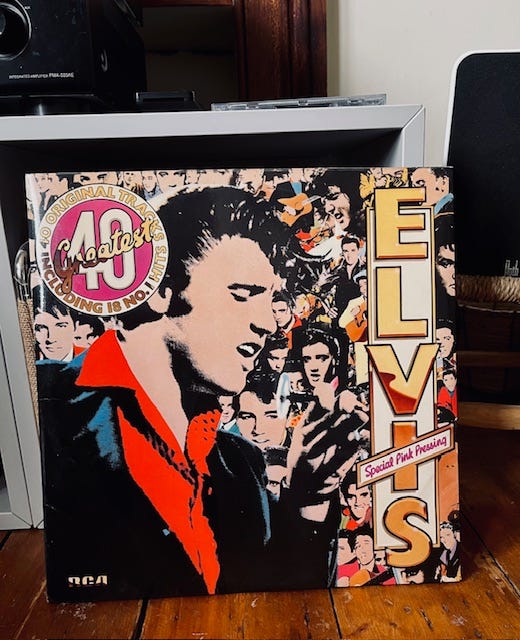
Altogether, it took me back to my own essence of Elvis. Before I knew anything of his story, I had Elvis 40 Greatest on double pink vinyl, the first record my parents ever bought me for me. I have my copy still, scratched and warped from all the times I played it on their old mono turntable record player, ten-years-old, ears pressed to the speaker, trying to figure out the words he was singing. To me then, Elvis was music. In EPiC, it’s everything he is again.
The Elvis biography exists in the margins of EPiC. The manipulations of Tom Parker in asides. His bloat in the later scenes. His dead pinned eyes in one interview segment. The ruin of him foretold. Luhrmann doesn’t follow him into the abyss, there’s nothing here from his last, tragi-pathetic Vegas residency and tour of 1976. Rather, there is a snatch of Elvis singing the line from ‘American Trilogy’, “you know your daddy’s bound to die,” a catch of something fleeting across the faces of The Sweet Inspirations – concern, fear, trepidation, knowing? There and gone but profoundly moving all the same.
THIS ISN’T EITHER A holding to account. Elvis as cultural appropriator, his courtship of the child Priscilla Beaulieu, Nixon’s wannabe lackey, his drugged-out dislocation, the full complicated mess of him, none of it is up for scrutiny under Luhrmann’s lens, and none of it matters one jot in this context.
What does matter, what says all that really needs ever be said about Elvis, happens towards the end of the film and in five awesome minutes. This is the time it takes for ‘Suspicious Minds’ to wind up and crescendo, and with Elvis’ spasmic gyrations to each shotgun-crack of the mighty Ronnie Tuff’s snare drum. I sat watching it unfold with mouth agape, heart beating fast, thrilled, immersed, overwhelmed.
It’s taken from 1970. The Beatles have imploded, The Stones are off making Sticky Fingers, Dylan’s gone country, outside the Vietnam War rages, protest, discontent, and revolution are fermenting in the air, Nixon’s Watergate is in the wind, and this is a bejewelled man playing with a big showband in a cabaret room. And he is completely extraordinary. Raw, primal, human dynamite. Fourteen hours later, I believe it to be the single most magnificent, colossal performance I’ve ever witnessed. One other apart, its equal, Ali, the Rumble in the Jungle, in another brilliant documentary, When We Were Kings from 1996.
Like Ali, at core Elvis knew himself best. Luhrmann captures him speaking his truth. “I am,” he demurs, “just an entertainer.” One, though, like no other before or since, or likely ever.